IN BRIEF
For a decade, enterprises focused on automating execution. The next decade will be defined by how well they automate decisions. Four numbers frame the shift:
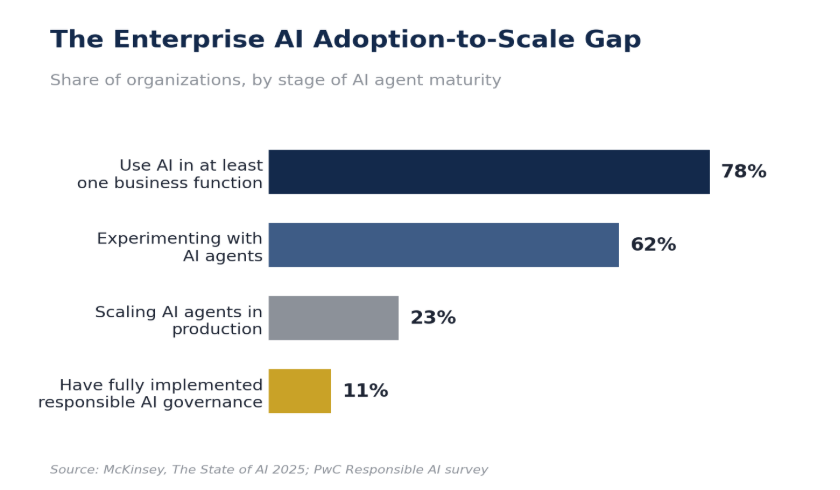
- 78% of organizations now use AI in at least one business function — up from 55% two years earlier. (McKinsey, 2025)
- Only 23% have scaled an AI agent into production in even one function, despite 62% experimenting. (McKinsey, 2025)
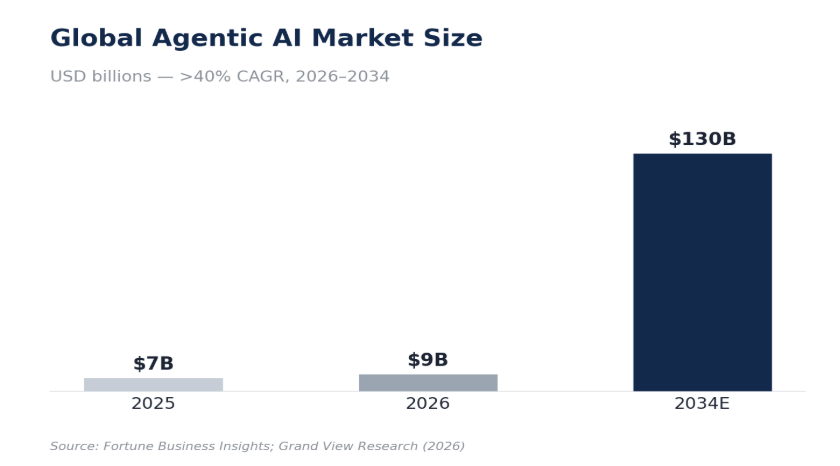
- $9B → $130B+ is the projected growth of the global agentic AI market between 2026 and 2034. (Fortune Business Insights)
- $2.6–4.4 trillion in annual global economic value could come from generative AI productivity gains. (McKinsey)
The Automation Era Has Reached Its Limit
For more than a decade, enterprise transformation has been driven by a single objective: automating work. Organizations invested in workflow automation, Robotic Process Automation (RPA), process mining, analytics, and artificial intelligence to improve efficiency, reduce operational costs, and eliminate repetitive tasks. That investment has paid off at scale — McKinsey’s State of AI 2025 report found that 78% of organizations now use AI in at least one business function, up from 55% just two years earlier.
Yet execution is no longer the primary constraint on enterprise performance. Decision-making is. Modern enterprises operate in environments where information is fragmented across business applications, enterprise systems, documents, emails, regulations, and rapidly shifting market conditions. Gartner projects that by 2028, 33% of enterprise software applications will include agentic AI capabilities, up from less than 1% in 2024 — a shift that will fundamentally change how decisions are made across organizations. Even as operational activities have been automated, organizations still depend heavily on people to interpret information, resolve exceptions, coordinate actions, and determine what should happen next.
The challenge, in other words, is no longer how to automate another process — it is how to make better decisions, faster, more consistently, and at enterprise scale. This is the shift Agentic AI is bringing to the enterprise conversation.
From Language Models to Autonomous Agents
Deloitte’s State of Generative AI in the Enterprise research found that more than two-thirds of organizations have already moved past experimentation and are actively scaling generative AI initiatives. Analysts broadly agree on where that trajectory leads: the global agentic AI market, estimated at roughly $9 billion in 2026, is projected to surpass $130 billion by 2034 — a compound annual growth rate above 40%, according to Fortune Business Insights and Grand View Research.
That growth reflects a shift in what enterprises expect from AI. Large language models can summarize documents, generate content, analyze information, and answer complex questions with remarkable speed — but enterprise transformation requires more than intelligent responses. Real business operations span multiple systems, departments, policies, and stakeholders, and require context, planning, collaboration, governance, and continuous adaptation. An intelligent answer is valuable; an intelligent decision is transformational.
This is the distinction between traditional AI and Agentic AI. Traditional AI responds to prompts; Agentic AI works toward objectives. Rather than waiting for individual instructions, AI agents understand business goals, maintain context, reason through multiple alternatives, select the appropriate enterprise capabilities, and continuously adapt as conditions change. Instead of automating a single activity, they orchestrate an entire business outcome.
Consider customer onboarding. Rather than simply extracting information from documents, an AI agent can validate customer data, retrieve information from enterprise systems, coordinate compliance checks, assess risk, initiate downstream processes, collaborate with other specialized agents, and involve human experts only when business judgment is required. The result is not simply faster execution — it is intelligent, adaptive decision-making embedded within everyday business operations.
Orchestration Is the New Operating Model
Enterprise intelligence is not created by a single AI model — it emerges from the ability to orchestrate people, enterprise knowledge, business applications, automation technologies, and AI capabilities into one connected operating model. In this model, enterprise platforms provide trusted business data, automation executes repetitive activities, AI models generate insights, and human expertise delivers strategic judgment.
AI agents become the orchestration layer that connects these capabilities — determining when to retrieve information, invoke enterprise applications, trigger automation, collaborate with other agents, or escalate decisions to people. The result is not a set of disconnected technologies operating independently, but an adaptive enterprise capable of responding intelligently to continuous change.
The Governance Imperative
As Agentic AI moves from experimentation to enterprise-wide adoption, success will depend on far more than technical capability. PwC estimates that only 11% of executives have fully implemented responsible AI governance, despite increasing regulatory expectations — and that gap between ambition and readiness shows up directly in adoption data. McKinsey’s State of AI 2025 survey found that 62% of organizations are experimenting with AI agents, but only 23% have scaled an agent in even one business function.
Organizations must build systems that are secure, transparent, observable, governed, and aligned with regulatory and business requirements. Intelligence without governance cannot scale; autonomy without trust cannot be adopted. The organizations that lead the next generation of enterprise AI will be those that successfully balance autonomous decision-making with human oversight, operational resilience, and responsible AI practices.
The Economics of Agentic AI
Every major technology shift has redefined how enterprises create value: cloud transformed infrastructure, automation transformed execution, and Agentic AI is now transforming decision-making itself. Competitive advantage will increasingly belong to organizations capable of combining human expertise with intelligent agents that can reason, collaborate, learn, and act across complex enterprise environments.
The scale of that opportunity is already visible in the numbers. McKinsey estimates that generative AI could contribute between $2.6 trillion and $4.4 trillion annually to the global economy through productivity gains — and that opportunity is already showing up in enterprise budgets. Gartner forecasts that worldwide AI spending will reach $2.52 trillion in 2026, a 44% increase year-over-year, as organizations shift investment from experimentation toward AI infrastructure and production deployment.
Key data at a glance
| Metric | Value | Source |
| Organizations using AI in ≥1 business function (2025) | 78% | McKinsey, State of AI 2025 |
| Enterprise apps expected to include agentic AI (2028E) | 33% | Gartner |
| Organizations experimenting with AI agents | 62% | McKinsey, State of AI 2025 |
| Organizations scaling AI agents in production | 23% | McKinsey, State of AI 2025 |
| Executives with fully implemented responsible AI governance | 11% | PwC |
| Global agentic AI market, 2026 → 2034E | $9B → $130B+ | Fortune Business Insights; Grand View Research |
| Worldwide AI spending (2026) | $2.52T (+44% YoY) | Gartner |
| Potential annual economic value from generative AI | $2.6T – $4.4T | McKinsey |
The question enterprises face is no longer how many processes can be automated. It is how intelligently an organization can make decisions at scale.
Turning Strategy Into Enterprise Value
Building enterprise-ready Agentic AI requires more than deploying models or creating intelligent agents. It requires a deep understanding of business processes, enterprise architecture, system integration, automation, and governance — especially in complex enterprise environments.
At Linktera Robotics, we believe the real value of Agentic AI begins where traditional automation reaches its limits.
For example, in a project we are delivering for a leading global automotive manufacturer, we are using Agentic AI to classify, interpret, and understand incoming invoices. The process requires contextual understanding and decision-making that cannot be effectively handled by traditional rule-based RPA, while performing the same work manually creates a significant operational workload.
In another project, we combine RPA and Agentic AI for production planning. Robots collect the required operational data from multiple source systems, while AI agents interpret that data and use it to create production plans. Here, RPA handles the structured execution and data collection, while Agentic AI adds the reasoning and decision-making layer.
These examples represent an important shift in enterprise automation: robots can execute, agents can reason, and together they can automate processes that were previously difficult or impossible to automate end-to-end.
Across industries and departments — from finance and manufacturing to operations, procurement, customer service, compliance, and IT — we are already working on Agentic AI use cases that address complex, unstructured, and decision-intensive processes.
The next wave of enterprise automation is not simply about automating more tasks. It is about making previously unautomatable work automatable.
If you would like to explore real-world Agentic AI use cases relevant to your organization, contact Linktera Robotics to discover where agents can create measurable business value.